
Experienced F2B Visa Attorneys in New York
Ready to reunite with your adult children? Our New York F2B visa lawyers help unmarried sons and daughters of green card holders navigate the family preference process.
Need Help with Your F2B Visa Application?
The F2B visa enables lawful permanent residents (green card holders) of the United States to sponsor their unmarried sons and daughters, who are 21 years of age or older, for lawful permanent residency. It serves as an essential pathway for families who have been separated due to immigration restrictions but still wish to reunite in the U.S.
At Sharma Law Associates, LLC, our New York immigration attorneys help families navigate the complex F2B visa process with precision, care, and strategy. We understand the importance of parents and adult children being together, and we work diligently to overcome the challenges associated with preference-based visa categories.
Contact us today at 646-360-5955, online, or schedule a personalized consultation on our calendar to learn more about our services.
What is an F2B Visa?
The F2B visa falls under the Family Second Preference (F2) category of U.S. immigration law. It is designed explicitly for unmarried adult children (21 years or older) of lawful permanent residents. Unlike the F2A visa, which applies to spouses and minor children, the F2B category is for older dependents who no longer qualify as “immediate relatives.”
Because the F2B visa is subject to annual quotas, the waiting period can be lengthy, often spanning several years, depending on the applicant’s country of origin. However, with careful planning and consistent case monitoring, families can prepare for each stage and ensure no opportunity is missed once the priority date becomes current.
Our F2B visa lawyers in New York provide comprehensive legal guidance, from petition filing to final consular processing, ensuring you stay compliant with all requirements.
Who Qualifies for an F2B Visa?
Eligibility for an F2B visa is based on both the status of the sponsoring parent and the relationship between the applicant and the sponsor.
To qualify, the following conditions must be met:
The petitioner must be a lawful permanent resident (green card holder) of the United States.
The beneficiary must be the unmarried son or daughter, age 21 or older, of the petitioner.
The relationship must be supported by legitimate documentation, such as a birth certificate or legal adoption papers.
The petitioner must be able to demonstrate adequate financial means to support the family member through an Affidavit of Support (Form I-864).
The beneficiary must be admissible to the United States under immigration law (no serious criminal convictions, health-related grounds, or previous violations).
At Sharma Law Associates, our New York F2B visa attorneys thoroughly review each case to confirm eligibility and identify potential obstacles early, including issues with documentation, prior immigration history, or changes in family circumstances.

How the F2B Visa Application Process Works
The F2B visa process involves multiple stages and can span several years, particularly when the visa category experiences retrogression. Our F2B visa lawyers in New York help ensure that each phase of your petition is handled correctly and efficiently.
Step 1: Filing Form I-130 (Petition for Alien Relative)
The sponsoring parent files Form I-130 with U.S. Citizenship and Immigration Services (USCIS). This petition establishes the qualifying family relationship. Supporting evidence, such as the birth certificate, proof of lawful permanent residence, and other relevant documents, must be included.
Step 2: Priority Date Assignment
Once USCIS accepts the petition, it assigns a priority date, which determines your place in the visa queue. Because F2B visas are subject to annual caps, applicants must wait until their priority date becomes current, as per the Department of State’s Visa Bulletin.
Step 3: USCIS Approval and NVC Processing
When USCIS approves the petition and a visa number becomes available, the case is transferred to the National Visa Center (NVC). Applicants must then submit additional forms, pay fees, and provide supporting documentation, such as civil records and financial evidence.
Step 4: Consular Processing or Adjustment of Status
If the beneficiary is outside the United States, they will complete consular processing and attend an interview at a U.S. consulate abroad. If they are lawfully present in the U.S. and a visa number is available, they may apply for Adjustment of Status (Form I-485) to become a permanent resident without having to leave the country.
At every step, our New York F2B visa attorneys manage documentation, coordinate communication with the NVC, and prepare applicants for their interviews.
Common Challenges in F2B Visa Cases
Due to the lengthy processing times and evolving immigration policies, F2B visa cases frequently encounter obstacles that can delay or jeopardize approval.
Common issues include:
Delays caused by visa retrogression in the monthly Visa Bulletin.
Incomplete or inconsistent documentation, leading to Requests for Evidence (RFEs).
Changes in marital status, since marriage automatically disqualifies F2B beneficiaries.
Financial challenges related to meeting the minimum income requirement for sponsorship.
Administrative processing delays or errors at the consular stage.
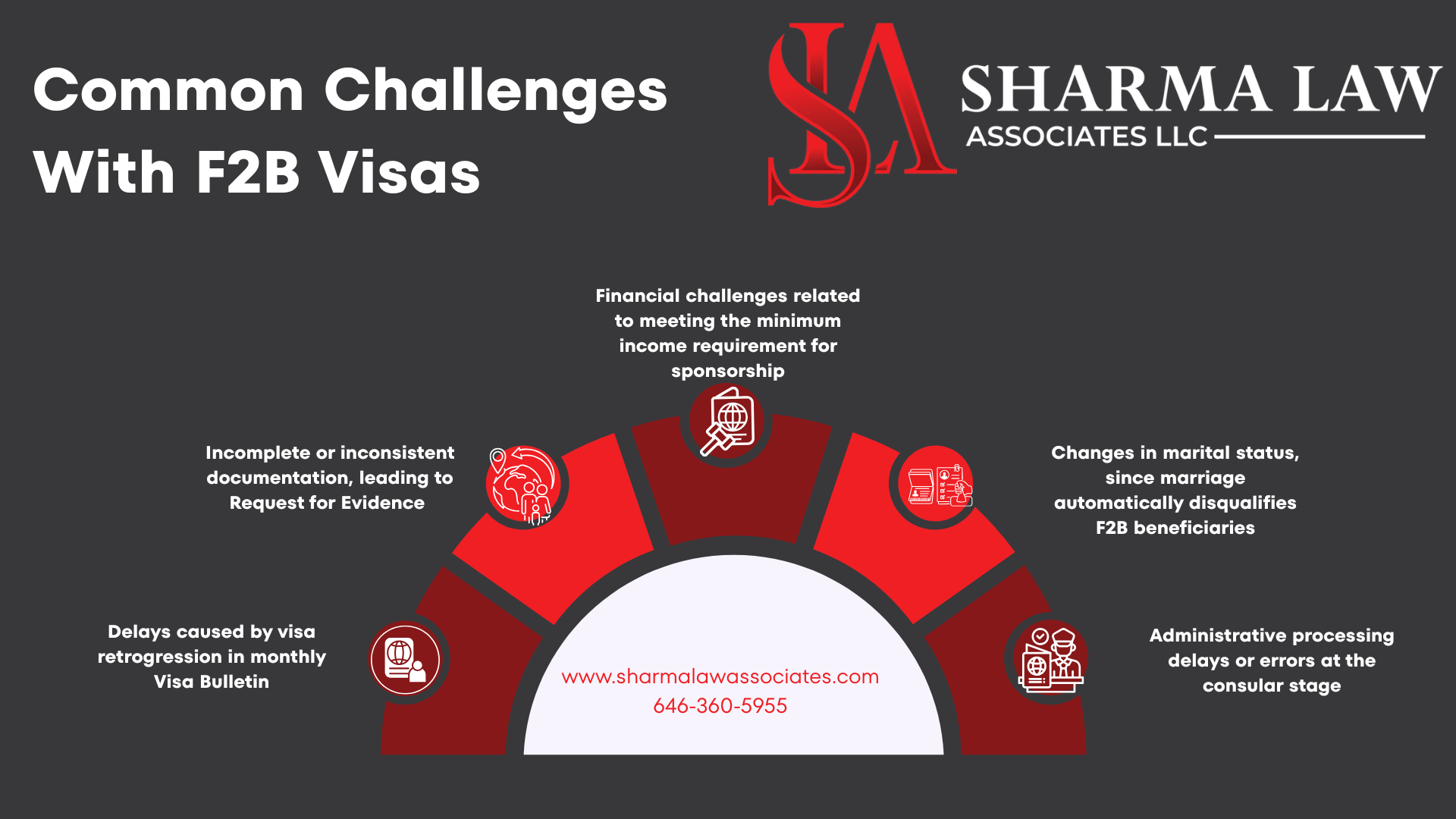
Our F2B visa lawyers in New York address these challenges proactively, helping families avoid costly mistakes and maintain readiness when the visa becomes available.
Maintaining Eligibility During the Waiting Period
Because the F2B process can span several years, beneficiaries must take steps to maintain eligibility.
Key considerations include:
Remaining unmarried until the visa is issued.
Updating USCIS and NVC of address or contact changes.
Keeping documents such as birth certificates and passports current.
Ensuring the petitioner maintains lawful permanent resident status (or upgrades to U.S. citizenship, if applicable).
If the sponsoring parent becomes a U.S. citizen during the waiting period, the F2B petition can often be upgraded to the Immediate Relative (IR) category, significantly reducing wait times. Our New York F2B visa attorneys handle these adjustments seamlessly to prevent disruptions in processing.
Why Hire a New York F2B Visa Attorney?
Applying for an F2B visa involves patience, precision, and persistence. The process can be complex and time-sensitive, particularly when coordinating between USCIS, NVC, and the U.S. consulate.
At Sharma Law Associates, LLC, our F2B visa attorneys in New York provide:
Comprehensive case evaluations to confirm eligibility.
Preparation and submission of all required petitions and evidence.
Strategic communication with USCIS and NVC to prevent delays.
Ongoing monitoring of visa bulletin movement and case progress.
Guidance on maintaining eligibility and preparing for consular interviews.
With decades of experience and a commitment to family unity, our attorneys provide both the legal experience and personal care necessary to help families navigate this complex process successfully.
Speak With Our New York F2B Visa Lawyer Today
Reuniting parents with their adult children is one of the most rewarding parts of immigration law. At Sharma Law Associates, LLC, we understand the importance of every family connection and provide the skilled, compassionate representation you deserve.
Whether you’re just beginning the process or waiting for your priority date to become current, we can guide you every step of the way.
Call us today at 646-846-4221, contact us online, or schedule a personalized consultation on our calendar to speak with an experienced F2B visa attorney in New York and start your path toward family reunification.
Frequently Asked Questions for F-2B Visa Services Attorney
-
Simply having a pending F2B petition does not provide employment authorization in the United States. A beneficiary must independently qualify for a work-authorized immigration status or receive employment authorization through another immigration process.
-
An F2B beneficiary's unmarried children under 21 often qualify as derivative beneficiaries and may immigrate with the principal applicant. However, age-out concerns and visa availability issues can affect eligibility, making long-term planning important.
-
Not necessarily. Many individuals who were previously denied visitor visas, student visas, or other nonimmigrant visas may still qualify for an F2B visa. However, the reason for the prior denial should be carefully reviewed to identify any issues that could affect the immigrant visa process.
-
Possibly. Some beneficiaries may qualify for a visitor visa or other temporary immigration status while an F2B petition is pending. However, immigration officers may closely examine whether the applicant intends to return home after the temporary visit.
-
Because F2B cases often take years to complete, beneficiaries should maintain organized records throughout the process. Important documents may include passports, civil records, prior immigration documents, and any correspondence received from USCIS or the National Visa Center.
-
A legal name change does not automatically affect eligibility, but inconsistencies in records can create delays if not properly documented. Beneficiaries should maintain evidence explaining any differences that appear on passports, birth certificates, educational records, or immigration documents.
-
Not necessarily. Consular officers frequently conduct immigrant visa interviews in the local language of the country where the interview takes place. The language used often depends on the applicant's location and the practices of the individual U.S. embassy or consulate.
-
In some situations, yes. If a beneficiary relocates to another country while the case is pending, it may be possible to request that processing occur through a different U.S. embassy or consulate. The transfer process typically requires coordination with the National Visa Center and the appropriate consular post.