
Experienced F3 Visa Attorneys in New York
As a married son or daughter of a U.S. citizen, you deserve a clear path home. Our New York F-3 visa lawyers guide your family reunification journey.
Need Help with Your F-3 Visa Application?
The F3 visa provides an essential opportunity for U.S. citizens to sponsor their married sons and daughters, along with those children’s spouses and unmarried minor children, to come live permanently in the United States. As part of the Family Preference immigration categories, this program allows families separated by distance to reunite under lawful permanent resident status.
At Sharma Law Associates, LLC, our New York immigration attorneys have deep experience helping families navigate complex immigration processes, including the F3 visa. We guide clients through every stage, from petition filing to consular interviews, ensuring that each case is handled with precision and care.
What is an F3 Visa?
The F3 visa is part of the Family-Based Immigration – Third Preference (F3) category, which enables U.S. citizens to sponsor their married children (21 years or older) for lawful permanent residency. It also extends to the spouses and unmarried minor children of those married sons and daughters, creating a multi-generational pathway for family reunification.
Unlike immediate relative visas (which are not capped annually), the F3 category is subject to strict numerical limits each year. As a result, visa backlogs and waiting times can extend for several years, depending on demand and the applicant’s country of origin.
At Sharma Law Associates, our F3 visa lawyers in New York help families stay organized and informed throughout the process, ensuring that every opportunity for a timely and successful immigration outcome is maximized.
Who Qualifies for an F3 Visa?
Eligibility for an F3 visa is based on both the petitioner’s U.S. citizenship status and the family relationship between the petitioner and the applicant.
To qualify for an F3 visa:
The petitioner must be a U.S. citizen (lawful permanent residents are not eligible to file under F3).
The beneficiary must be the married son or daughter (age 21 or older) of the U.S. citizen.
The marriage must be legally valid and recognized in the country where it occurred.
The beneficiary’s spouse and unmarried children under 21 may be included as derivative beneficiaries.
The petitioner must demonstrate the ability to financially support the family member under Form I-864, Affidavit of Support.
The beneficiaries must be admissible to the United States, meaning they do not have disqualifying criminal, health, or prior immigration issues.
Our New York F3 visa attorneys provide detailed eligibility assessments, ensuring all qualifying relationships and requirements are properly documented from the start.

How the F3 Visa Application Process Works
Due to the long wait times associated with the F3 category, accuracy and preparation are essential at each stage. The process typically involves multiple agencies, including USCIS, the National Visa Center (NVC), and a U.S. consulate abroad.
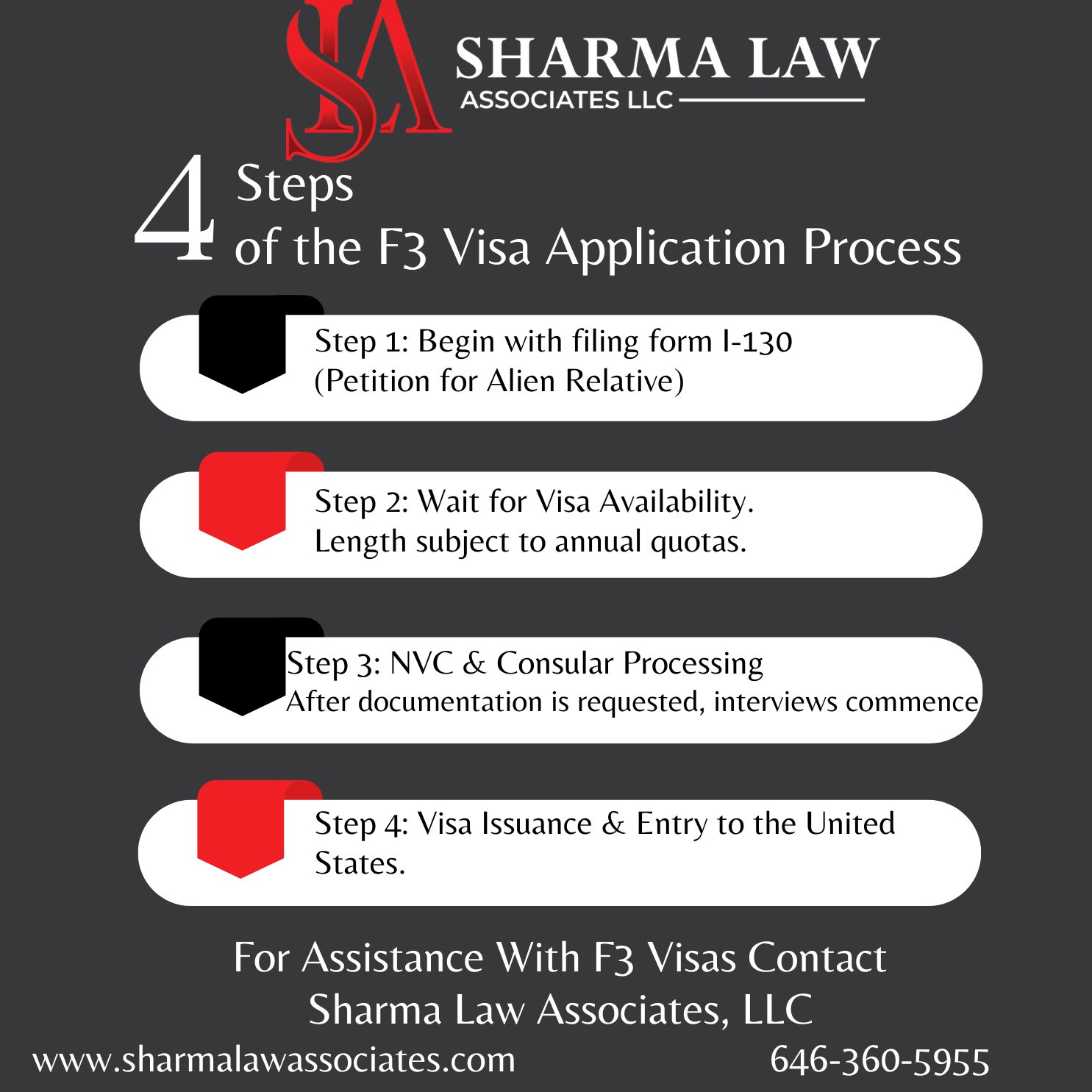
Step 1: Filing Form I-130 (Petition for Alien Relative)
The U.S. citizen sponsor begins by filing Form I-130 with U.S. Citizenship and Immigration Services (USCIS) to establish the qualifying family relationship. Supporting evidence, such as a birth certificate, proof of U.S. citizenship, and marriage documentation, is required to support your application.
Step 2: Waiting for Visa Availability
Once USCIS approves the I-130, the case is forwarded to the National Visa Center (NVC). The priority date (the date USCIS received the petition) determines when a visa will become available. Because the F3 visa is subject to annual quotas, applicants often face several years of waiting, depending on demand and their country of chargeability.
Step 3: NVC and Consular Processing
When the priority date becomes current according to the Visa Bulletin, the NVC will request additional documentation, including civil records and the financial Affidavit of Support. The case then proceeds to consular processing, where the beneficiary and their qualifying family members attend interviews at the U.S. consulate in their home country.
Step 4: Visa Issuance and Entry to the U.S.
Once approved, the family members receive their immigrant visas and can enter the United States as lawful permanent residents. Upon arrival, green cards are issued, granting the right to live, work, and study in the U.S. permanently.
At Sharma Law Associates, our F3 visa lawyers in New York guide clients through each of these phases, ensuring that all documents, deadlines, and interview preparations are handled with meticulous care and attention to detail.
Common Challenges in F3 Visa Cases
Due to its lengthy timeline and complex documentation requirements, the F3 visa process presents unique challenges. Our firm anticipates and resolves these challenges to prevent delays and denials, ensuring seamless operations.
Common issues include:
Long waiting periods leading to document expiration or lost correspondence.
Changes in family status, such as divorce or children aging out (turning 21).
Incomplete or outdated financial documentation under the Affidavit of Support.
Administrative delays at the National Visa Center or U.S. consulates.
Visa retrogression, when previously current priority dates move backward.
At Sharma Law Associates, our F3 visa attorneys in New York take a proactive approach to tracking case progress, maintaining communication with agencies, and keeping your family ready to move forward as soon as your visa number becomes available.
Maintaining Eligibility During Long Wait Times
Because F3 petitions often take years to mature, it is critical to maintain eligibility during the waiting period.
Beneficiaries and their families should:
Keep passports and civil documents current.
Update the NVC with any changes in contact information.
Notify USCIS or NVC of any changes in marital or family status.
Maintain consistent communication with the sponsoring family member in the U.S.
Our New York F3 visa lawyers provide ongoing support to families during this period, ensuring that all updates are handled correctly and that your file remains complete and active.
Why Hire a New York F3 Visa Attorney?
While the F3 visa process is a powerful way to bring families together, it can also be among the most complex due to its lengthy processing times and multi-layered eligibility requirements. Working with an experienced F3 visa attorney in New York ensures that every aspect of your case is handled with care and precision.
At Sharma Law Associates, LLC, we:
Conduct thorough case evaluations to confirm eligibility and filing strategy.
Prepare and file complete documentation with USCIS and NVC.
Monitor visa bulletin movement and communicate updates in real time.
Guide you through consular interviews and final approval stages.
Provide continued legal support during long waiting periods.
Our firm combines legal excellence with compassionate advocacy, helping families bridge distances and secure permanent futures in the United States.
Speak With a New York F3 Visa Lawyer Today
Reuniting with your married children and their families is one of the most meaningful goals of U.S. immigration law. At Sharma Law Associates, LLC, we take pride in helping families achieve that goal through dedicated representation and meticulous case preparation.
Whether you are just beginning the petition process or waiting for your priority date to become current, our F3 visa attorneys in New York are ready to assist.
Call us today at 646-374-3480, contact us online, or schedule a personalized consultation on our calendar to speak with a trusted F3 visa lawyer in New York and start building the path toward family reunification.
Frequently Asked Questions About F3 Visa Attorneys in New York
-
Possibly. Having a pending F3 petition does not automatically prevent someone from applying for a temporary visitor visa. However, because the applicant has expressed an intent to immigrate permanently, they may need to demonstrate that they still qualify for the temporary visa they are requesting and intend to comply with its terms.
-
The petitioner’s death can affect an F3 petition, but it does not necessarily mean the case must end. Depending on the circumstances, certain humanitarian provisions or substitute sponsorship options may allow the immigration process to continue. The available options depend on the facts of each case.
-
In many cases, yes. Children born after the original F3 petition is filed may still qualify as derivative beneficiaries if they otherwise meet the eligibility requirements. It is important to notify the appropriate immigration agencies and provide updated documentation as the case progresses.
-
Moving to another country while an F-3 petition is pending does not necessarily affect eligibility, but it may change where consular processing occurs. Applicants should promptly update their contact information and inform the appropriate agencies of any change in residence to avoid delays or missed correspondence.
-
An approved F3 petition alone does not authorize employment in the United States. Beneficiaries generally must have separate authorization to live or work in the country until they become lawful permanent residents through the immigration process.
-
No. Approval of Form I-130 confirms that USCIS recognizes the qualifying family relationship, but it does not automatically result in an immigrant visa. Applicants must still wait for a visa number to become available, complete all required processing, and satisfy the remaining eligibility requirements before a visa can be issued.
-
Yes. Because F3 cases often remain pending for several years, financial information submitted early in the process may no longer be current by the time a visa becomes available. Updated Affidavits of Support and supporting financial documentation are commonly required during later stages of the application process.
-
Long wait times can create unique challenges, including changes in family circumstances, expiring documents, government correspondence, and evolving immigration policies. An experienced immigration attorney can monitor your case, help ensure required updates are submitted, address unexpected issues as they arise, and prepare your family for the next stage once a visa becomes available.